
The early onset of the southwest monsoon brought continuous rainfall across southern and eastern India, contributing to this record.

An earthquake measuring 4.9 on the Richter scale hit Pakistan-occupied-Gilgit late on Tuesday night and resultant mild tremors were felt in Doda and Kishtwar districts of Jammu and Kashmir.

The department said Marathwada, Central Maharashtra and Central India will benefit the most.

Prime Minister Narendra Modi on Monday chaired a high-level meeting to review preparedness for the hot weather condition in the upcoming summer season and called for preparing separate awareness material for different stakeholders like common citizens, medical professionals, local body authorities and disaster response teams.

A district-wise data on the temperatures of the day.
A district-wise data on the temperatures of the day.

'Nobody asked us to work on this. It was on our own that we decided to embark on this journey.'

A siren giving a warning about tsunami erroneously started playing from the Early Warning Dissemination System at Porvorim near Panaji, triggering panic among the local residents, an official said on Thursday.

Mohapatra said there is a 40 per cent chance of a normal rainfall, 22 per cent above normal, 12 per cent excess and 18 per cent below normal.

In view of the discharge of water from the Khadakwasla, Mulshi, Pavana and other dams in the Pune region, Maharashtra Chief Minister Eknath Shinde directed authorities to be alert and shift people from dangerous zones to safer places.

Strong demand for cultural and spiritual hubs is expected for destinations like Varanasi, Kolkata during Durga Puja, and Pushkar for the camel fair, besides leisure destinations like Goa, Udaipur, Jaipur and Coorg.
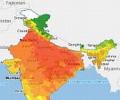
The infamous Indian summer lives up to its reputation as the heat wave continues to grip the country.

Skymet expects a good monsoon over western and southern India.

Southwest monsoon hit Kerala on Friday marking the start of the rainy season, four days after its normal onset date.

Map showing how much rainfall various districts of India received.

The India Meteorological Department (IMD) has predicted above-normal rainfall across India in June, with most parts of the country likely to experience normal to below-normal maximum temperatures. The IMD also anticipates above-normal minimum temperatures across most of the country, except for some parts of central India and the adjoining south peninsula. The southwest monsoon reached Kerala on May 24, marking its earliest arrival over the Indian mainland since 2009. The monsoon is crucial for India's agriculture-dependent economy, providing vital water for crops and supporting drinking water and hydropower generation.

"Conditions are favourable for the onset of southwest monsoon over Kerala and its further advance into some more parts of south Arabian sea, remaining parts of Maldives - Comorin area, some parts of Tamil Nadu and some more parts of Bay of Bengal during the next 24 hours," said a statement by the Indian Meteorological Department.

IMD data shows in the 24 hours between September 1 and 2, Haryana received 806 per cent more rainfall than normal, Punjab 759 per cent, Himachal Pradesh 510 per cent, Delhi 740 per cent, Chandigarh a staggering 1,638 per cent, and Rajasthan 193 per cent.

The method is based on a network analysis of regional weather data.
Massive preparedness, speedy evacuation plans and almost accurate prediction of cyclone time and path have saved the country from a natural disaster which could have taken thousands of live.
With heavy rain since Sunday and more being forecast for Tuesday, a cloud of uncertainty looms over the Indian Premier League's first qualifier between Kolkata Knight Riders and Kings XI Punjab, at the Eden Gardens. Both teams had to skip Monday's practice as the ground remained under cover.

Mercury hovered around 40 degrees Celsius in large parts of the country on Monday as the Indian meteorological department predicted heat wave conditions in parts of east India over the next four days and the northwest region over the next two days.

Here's a map showing the monsoon situation across the country.
The Indian Meteorological Department has forecast a below-normal monsoon this year because of the El-Nino effect.

Western Railway stated that local train services were running normally on Monday morning, however, commuters claimed trains were running late by 5 to 10 minutes.

The IMD director said, the cyclonic storm Tauktae in the Arabian sea is moving away from the Kerala coast and is now approaching the Karnataka coast.

More than 150 express/passenger trains running through South Eastern Railway jurisdiction have been cancelled in view of the severe cyclonic storm, an SER official said.
Because the ecology of various regions differs, it is silly to club them all under one countrywide average number, says Nitin Sethi.

The above map shows the amount of rainfall received by each district from June 1 to July 24, 2019.
The tremor measuring 5.3 on the Richter scale was recorded at 0106 IST. The epicentre was at 6.2 degrees North Latitude and 92.2 degrees East Longitude.

IMD Director General Mrutunjay Mohapatra said the department's modelling indicate formation of a cyclonic storm around May 9, but its movement and intensification may be determined after the low pressure area actually forms on May 7.

Houses in low lying areas of Kerala were flooded in the heavy rains, while the accompanying strong winds uprooted trees, damaged homes and caused power disruptions, throwing normal way of life into disarray across the state.

The monsoon has finally brought back smiles to the faces of people, especially farmers, of India.

Several areas of Tamil Nadu remain inundated after hours of heavy to moderate rainfall in the region. Water entered houses and markets in the low-lying residential areas of Erode district due to heavy rainfall throughout the night.

Very heavy rainfall is likely to occur at one or two places in Kerala on Wednesday.

The south-west monsoon, crucial for the country's agriculture-based economy, is likely to hit the Kerala coast by June 2, the Indian Meteorological Department said on Thursday.
North India was shaken by an earthquake of 5.7 magnitude on Richter Scale this evening but there was no immediate report of any loss of life or property. The quake occurred at 5:02 pm, the Indian Meteorological Department said.

Landslides blocked arterial roads leading up to Dharali where dozens of people were trapped and many homes and cars swept away by the raging waters on Tuesday. Eleven Army personnel from the nearby camp in Harsil were among those missing.

There are conflicting reports about the magnitude of the earthquake that shook Delhi and its adjoining areas. While the Indian Meteorological Department measured the quake at a scale of 4.9, the United States Geological Survey put the magnitude at 5.2 on the Richter scale.
